Kick Start Mindfulness with Solo Travel
‘Mindfulness helps you step outside the endless chatter of your thoughts and see the world with fresh eyes, reinstating a sense of wonder’ (Williams & Penman)
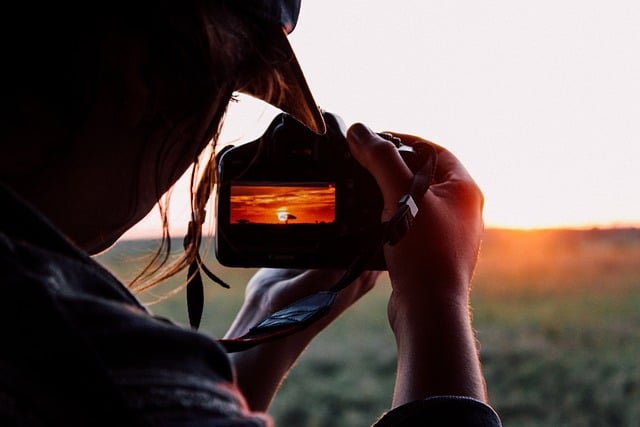
Spending time alone, can be one of life’s greatest gifts; an opportunity to flower into self-awareness and to truly just be in the moment.
Solo travel can be a chance to embrace the rich fullness of NOW
There are no short cuts to mindfulness, it takes a commitment and practise, but solo travel could be an enjoyable way to begin. This article will provide helpful tips on how to kick start mindfulness whilst travelling solo.
Why do I want to be mindful?
The concept of being present or mindful has firmly taken root in recent years as an antidote to stress and anxiety.
Let’s face it, you can’t do anything these days without someone telling you to be more mindful – diligent workplaces are holding half day mindfulness workshops in a hope that their employees will be happier (and presumably more productive), doctors are prescribing mindfulness courses and colleges are promoting it to young minds in a bid to reduce the surge in anxiety disorders.
There is a very valid reason for the sudden omnipresence of mindfulness, and that is that it really works!
Dating back over 2500 years, Buddhists have long extolled the benefits of being mindful and as contemporary western thinking gradually catches up, there is a strong consensus amongst experts from a variety of fields that there is a direct correlation between our ability to stay in the present moment and our happiness levels.
Furthermore, as scientists increasingly discover the harmful effects of stress on our physical health, it is slowly being accepted that mindfulness can play a key role in maintaining health.
The Benefits of Mindfulness include:
- less anxiety and depression
- reduced stress levels
- healthier body and less prone to illness
- less emotional reactivity
- increased compassion and empathy
- better focus and creativity
Practising mindfulness helps us feel more in control of our thoughts and feelings. It gives us the mental strength to deal with challenges when they arise.
What is mindfulness?
Being present or mindful simply means being aware of your thoughts, and feelings as they arise in the present moment, without labelling them and judging them.
Mindfulness is not about sitting with your legs crossed and clearing your mind of all thoughts, though this can also be an excellent practice; it’s about being aware day to day – whether you’re sat in a meditation pose, sitting on a bus, walking down the street, buying a new pair of shoes…
World renowned spiritual teacher, Eckhart Tolle suggests that ‘as soon as you honour the present moment, all unhappiness and struggle dissolve, and life begins to flow with joy and ease. ‘(2004).
Sounds good, doesn’t it? However, as most of us spend our waking hours wandering from one thought to another, it’s easier said than done. In the words of my recent Qigong instructor in Malaysia, she said we all have monkey minds playfully and annoyingly chattering from the minute we wake up to minute we fall asleep.
To be mindful, is to be aware of our monkey minds.
How can solo travel kick start mindfulness?
Solo travel gives you the perfect opportunity to experience and practise presence.
Imagine this. You’re in Florence, sat at a pavement café in a bustling side street just off the Piazza Del Duomo. The Cathedral’s striking terracotta dome towers in magnificence. Boxes of vibrant magenta geraniums adorn the window ledges. The sun shines bright. A fruit-seller opposite sells mounds of large ripe fragrant peaches, spears of fresh asparagus and crates of perfectly formed globe artichokes. People gather and chat animatedly. The theatre of life playing out in front of you. And there you are with your perfect Italian coffee. Perfectly present observing the scene playing out in front of you.
Where else do you need to be?
Well, you could be on your mobile, planning your next move, texting, reporting all you see on social media. However, if you choose, you can make the conscious decision to simply take in the joy of the present moment, and if you do your experience will be richer for it and your mind and body will sigh with relief.
Travel in general, alone or otherwise can be great for our mental health. Have you ever noticed that when we take a few weeks holiday and leave the everyday stresses of homelife behind, how we suddenly feel a sizeable weight lift from our shoulders? Those nagging working issues, the disagreement we were having with a friend, suddenly seem to take on less importance when we change our surroundings and take a mental break. Have those issues gone, evaporated? It’s doubtful, but your mind is no longer fixated on them. Travel allows us to gain some perspective and to see the bigger picture.
All travel offers the opportunity to practice presence, but the benefit of being solo, is that you are acutely more aware of your surroundings. It’s as though your senses sharpen, and the world becomes richer in texture, smell, taste and sound – your eyes zoom in on the finer details, colours seem more vivid, people more animated, tastes more satisfying, smells more intense and sounds more invigorating. You have the perfect opportunity to practice being more mindful (if you choose to).
Of course, we certainly do not need to travel solo to practise being mindful. To have the most benefit mindfulness needs to be a life practice. Only then will it help us deal with life challenges more effectively and with greater self-awareness and compassion.
However, solo travel does give us a great opportunity to kick start or perhaps further develop a more mindful way of being. Perhaps it’s been something you’ve been meaning to do, but haven’t got around to it – well here’s the perfect chance.
There are a few things that make practising presence when we’re travelling solo slightly easier:
- The break from routine and lack of responsibility – this helps to pull you out of those habitual thought patterns.
- Away from familiar cues – by being in a new location you’re away from familiar cues, and your mind can have a little spring clean.
- No companion to distract you – without a companion to distract you, you have every opportunity to indulge in the present moment.
How to cultivate mindful solo travel
Wouldn’t it be good if simply the act of travelling solo resulted in greater mind awareness? But of course, it doesn’t work like that. Mindfulness is a skill, it requires work and practise and wherever we are in the world, our monkey minds like to chatter, it’s what they’re designed to do. It doesn’t matter how many courses you do or how many books you buy, the only way to become more mindful is to practise, practise, practise….
Here are some ideas of how we can practise being more mindful whilst travelling solo and in turn have a more enriching travel experience.
Slow Down
Have you ever been on holiday and started to feel a sense of anxiety because you’ve not been to a certain must-see site? Or spent your time visiting so many art galleries, temples, ruins…that you groan at the site of another! I have.
It’s easy to fall into the trap of grabbing a guidebook and making a list of ALL the things you must see and do, and whilst you’re sat at home on your nice comfy sofa that list seems really exciting – who cares if you rush around like a headless chicken because at least you’ll be seeing all the bucket list sites! And yet, that long bewildering list can turn into a bit of a sun-soaked whirlwind with little time to breath, leaving many people complaining that they feel more exhausted on their arrival home than when they left.
I feel exhausted just thinking about it!
Instead, plan for a slower pace, take in less attractions and go to the ones you’re really passionate about. Plan to really savour them; to take them in fully, to allow your mind and body to really just be in this place of beauty that you may have imagined for so long. Far better to relish the experience and absorb it, rather than remember it with tired eyes.
Take public transport
We all love to get places quickly, but there is a lot to be said for appreciating the journey. Consider taking buses and trains, rather zipping around in a car or taking flights over short distances. By travelling slower and taking public transport, we get to appreciate the everyday life of our location, it’s kinder to the environment and supports the local economy.
Be mindful of culture and people
It’s always important to remember that we are guests in a country. There are some tourists, who seem to regard the locals as an add on to their holiday and part of the tourist attraction.
Consider, your own cultural biases and spend some time before you travel doing a bit of research on cultural expectations and local rules; this is especially important where there are significant cultural differences to what we are used to.
Stay present and don’t judge the people you encounter, simply accept what they’re doing, what they’re wearing, how they’re acting etc as opposed to placing your own values and expectations on to the people you meet. If you find your mind jumping in, with your own preconceived ideas, notice and let it go.
Just experience.
Reflect later and ask yourself what you may have learnt from the experiences and interactions.
Savour your meals
‘Savouring is actively aiming for the most joy to be found in a moment.’ Stephanie Rosenbloom (Alone Time)
There’s a wonderful book called Alone Time, by Stephanie Rosenbloom, and I recommend it to all solo travellers; it contains anecdotes and advice backed by research from a range of scientific fields on the benefits of spending time alone and finding joy through treasuring the moment.
Rosenbloom goes into detail about the pleasure of eating alone, savouring and staying present. She writes:
‘To share a meal is to undoubtedly experience one of life’s great joys. Yet this does not mean that there can’t be some kind of connection when we eat alone… We can breathe in and relish the flavours of a sauce, or the coolness of a pitcher of cream….A solo meal is an opportunity to go slow; to savour.’
Savouring, whether that be food or indeed anything else is closely linked to happiness. Rosenbloom references several studies, that have concluded that people who take the time to truly savour are happier and less anxious.
The old adage ‘it’s the little things in life that bring about the most pleasure’ rings true.
In theory it can seem like an easy prospect, to simply enjoy our food, and yet for many of us in our fast-paced multi-tasking eat on the go society eating mindfully may not be our daily reality.
Ask yourself how many times a week do you really taste in full the meal in front of you?
A few tips for savouring:
- put away all distractions.
- Attempt to distinguish individual flavours.
- Heighten the experience by focusing on different senses, how does the food taste? What is its texture? How does it smell? What can you hear around you?
- Eat with your non dominant hand to force yourself to slow down.
- Breath, notice your body, your environment and tune into your body.
- Remind yourself that this moment will not last, the meal will be gone and the trip will end. By doing this, we remind ourselves to savour (Byrant).
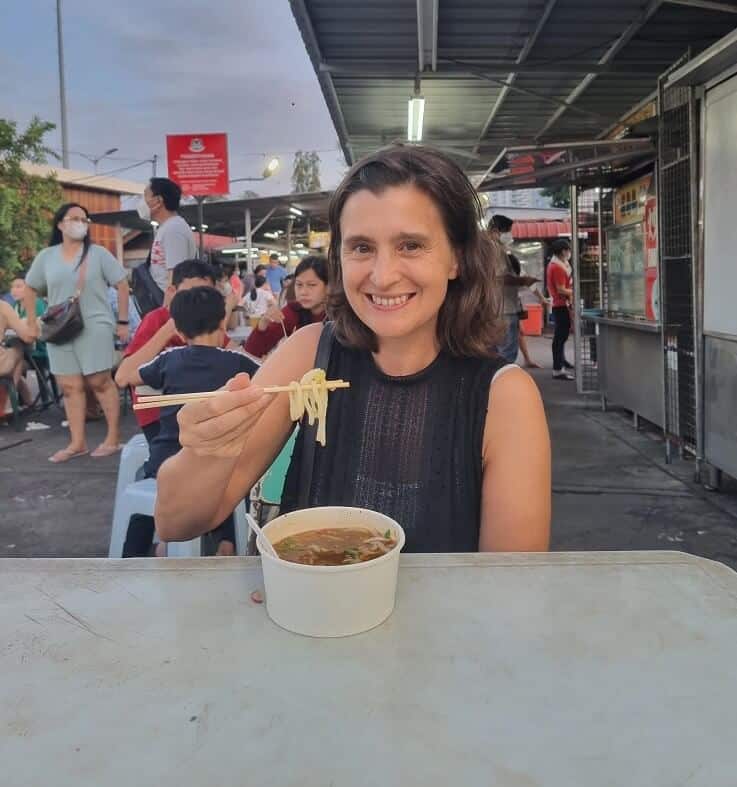
Take photographs mindfully
Snapping photos is part and parcel of being on holiday, and yet it is so easy to spend a great deal of that holiday time taking photo after photo without really taking in what’s in front of you; thus, losing the essence of the experience behind a viewfinder.
However, with greater awareness photography in itself can be a mindful practice.
Studies show that ‘when done thoughtfully, photography can be an effective way of improving mood and appreciation of everyday life” (Kurtz, 2015).
Consider a mindful approach to taking photographs. Here’s a few tips:
- Take time to savour before you take photographs, immerse yourself in the present moment; use your senses, what can you hear? what colours can you see? what can you smell? Ask yourself, how could I really capture this moment?
- Avoid imagining others viewing your photographs and what their opinions might be, as this will take you away from the present moment and reduce your enjoyment.
- Reduce the number of shots you take. It’s so easy to take endless photographs in a hope that one will be perfect. To be more present, reduce the number of shots. J. Sutton, from Positive Psychology, suggests setting yourself a daily limit. He states by ‘restricting yourself to three shots this will help you become more engaged in the process and the scene.’
- Leave your camera at home. By having camera free days, you give yourself permission to just really enjoy the present moment, and engage fully with life around you.
- Accept your photograph. In today’s visually drenched Instagram perfect photographs, it can be all to easy to be disappointed by what we’ve shot, and so begins the doctoring and visual enhancement to present perfection. Instead, ‘welcome what arises rather than chasing perfection or setting unrealistic expectations’ (J. Sutton).
By learning to welcome what arises, both good and bad, we are practicing mindfulness to a high level. The more we practice, the better we become and the more adept we will become at engaging with difficulties in life.
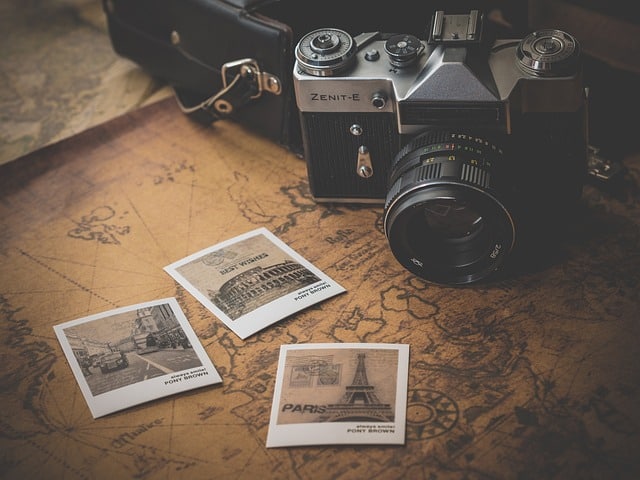
Pause screen time
We all know what it’s like to constantly be connected to our technology, and the hours that can go by simply by mindlessly scrolling, not to mention the tangents our brains can off simply by reading or seeing something on social media.
Perhaps for the solo traveller, reducing screen time can seem tricky as it may be regarded as a welcome distraction when alone, particularly in cafes and restaurants. However, set yourself to some time each day to have a break from technology and simply just be.
By disconnecting you connect more with your environment.
Furthermore, as we live in an age where the whole world is mapped, researched and reviewed on the internet there’s a tendency to over plan and to get side lined by someone else’ opinion of where to visit. Where’s the spontaneity? By ditching the screen, we automatically become more aware of the subtleties of our surroundings, remember more and relearn to take pleasure in discovering.
On a point of safety, as a solo woman traveller, I’d still suggest keeping your phone with you, but just make a decision not to use it for a few hours.
Be aware of you body
As you sit, as you stand, as you walk bring your attention to your body and your breath. It seems so simple, and yet it’s a powerful practice.
Whilst our monkey minds are racing, we are everywhere and nowhere.
By simply turning inward and noticing our bodies, and our breath we are no longer in the mind.
“If you keep your attention in the body as much as possible, you will be anchored in the now, you won’t lose yourself in the external world and you won’t lose yourself in your mind. Thoughts and emotions will still be there to some extent but they won’t take you over.” E. Tolle
Here’s a great explanation inner body awareness with Eckhart Tolle on YouTube.
Don’t fight your body
Being on holiday can be tiring – the travelling, the heat, the change of environment, the change of food – be mindful of what your body needs. If it needs to rest, take a siesta – you’ll feel better for it.
Incorporate activities to raise awareness
To assist your mindful travelling experience, incorporating activities that enhances self-awareness are both a great thing to do and also good places to meet like minded people, for example take classes in yoga, Tai Chi or Qigong, or seek out experiences such as sound baths, forest bathing and tea ceremonies.
Remember – It’s not easy!
‘Whatever you’re doing be aware of it’ anon
When I set out to write this article, I said to myself, okay Jenny, this will be part of your present moment practice, you will write it mindfully. Did I? Nope I did not. Not until, I’d faffed around a bit…
I began my note taking in a café, which is generally how I always start writing anything as I am old school and have yet to find a clear flow of thoughts between my brain and the screen. Picture – an outdoor café in Thailand surrounded by lush trees and plants, a trickling pond and gentle notes of tasteful music in the background. Perfect.
And yet, I needed my coffee to be a certain way, before I began, I took pictures of my coffee, I researched yoga retreats – pointless, as I wasn’t writing an article on yoga retreats, I googled mindful quotes, even though I already had lots, I checked my email even though there was no need, I checked my Instagram, I thought about my partner back home and a conversation I might have with him later in the day by zoom and so on….
So distracted!
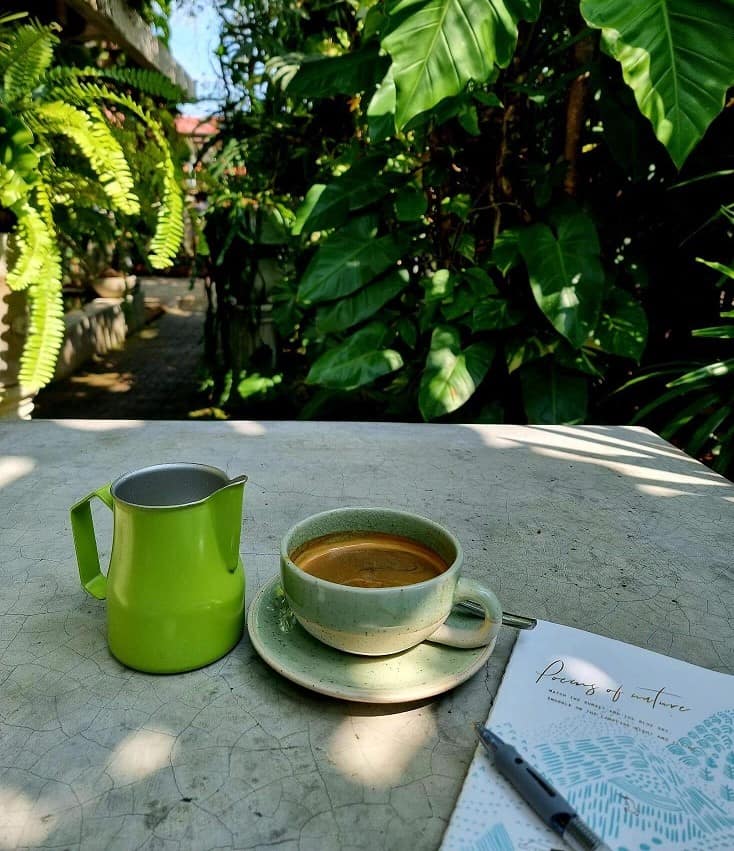
And yet, after 10 – 15 minutes of mindless multitasking, I came back to my article and what I was actually intending to write about. I checked in with my breath, it was shallow, with a noticeable tension in my chest, and in that moment I stopped.
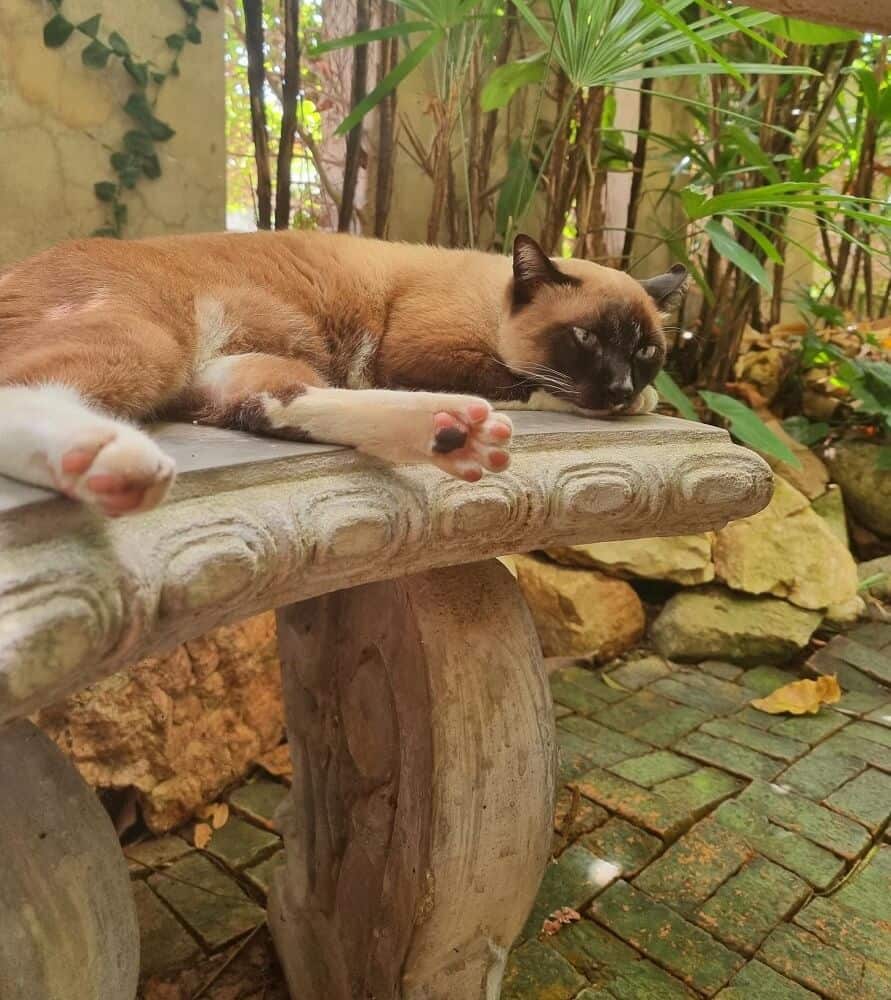
My awareness jumped in, I put everything down and tuned into my body and then my surroundings…the scent of citronella, the quiet Thai chat at a table nearby, the warmth of the sun relaxing my body, the very gentle, hardly noticeable sway of the established trees and plants in the warm breeze, casting shadows on my Romanesque style heavy stone table, the lulling trickle of water, the exotic tweets of bids singing songs so different to those back home and a cat, Burmese I think with beautiful blue eyes, lounging languidly on the stone floor… My phone on the table, momentarily and mindlessly I reached for it, such is the compulsion but I stopped and again returned to the present moment.
Mindfulness takes practice, we shouldn’t chastise ourselves for the times when we are not mindful. If we were mindful all the time, you might be high fiving Eckhart Toll and Oprah might be ringing for an interview.
It’s in those moments when you notice your mind wandering, those moments where your monkey mind is ruling and you become aware of it, that you raise your consciousness. And your brain, like all parts of your body, responds to being worked out. The more often you notice your monkey mind, and return to the present moment, the easier it will get.
Recommended books:
I love these two books.
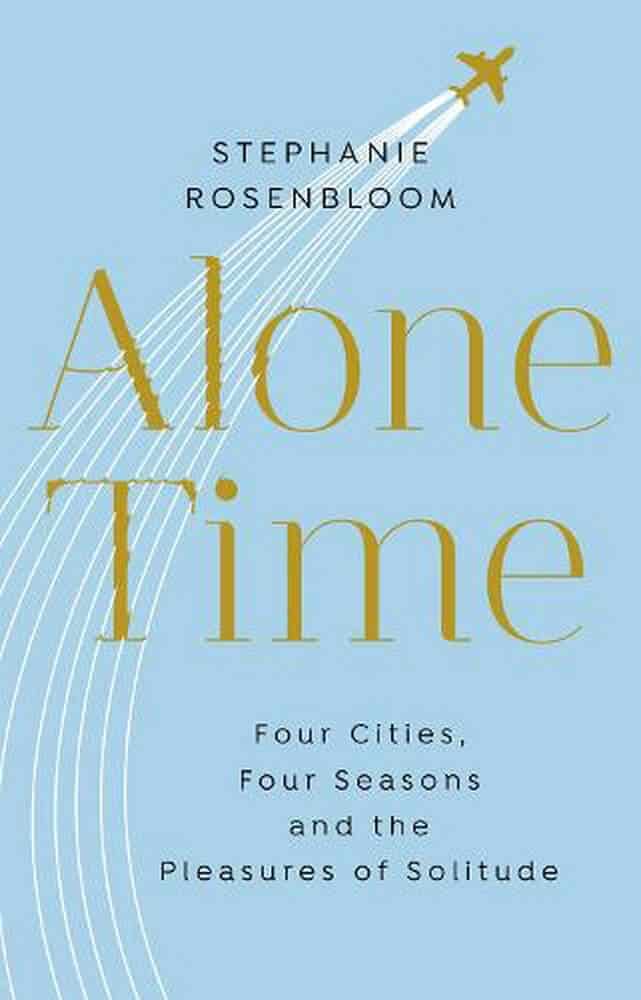
Stephanie Rosenbloom’s, Alone Time: Four Seasons, Four Cities, and the Pleasures of Solitude, is beautifully written with immersive solo travel stories in Paris, Florence, Istanbul and New York. Alone Time introduces you to the art of solo travel and savouring the present moment.
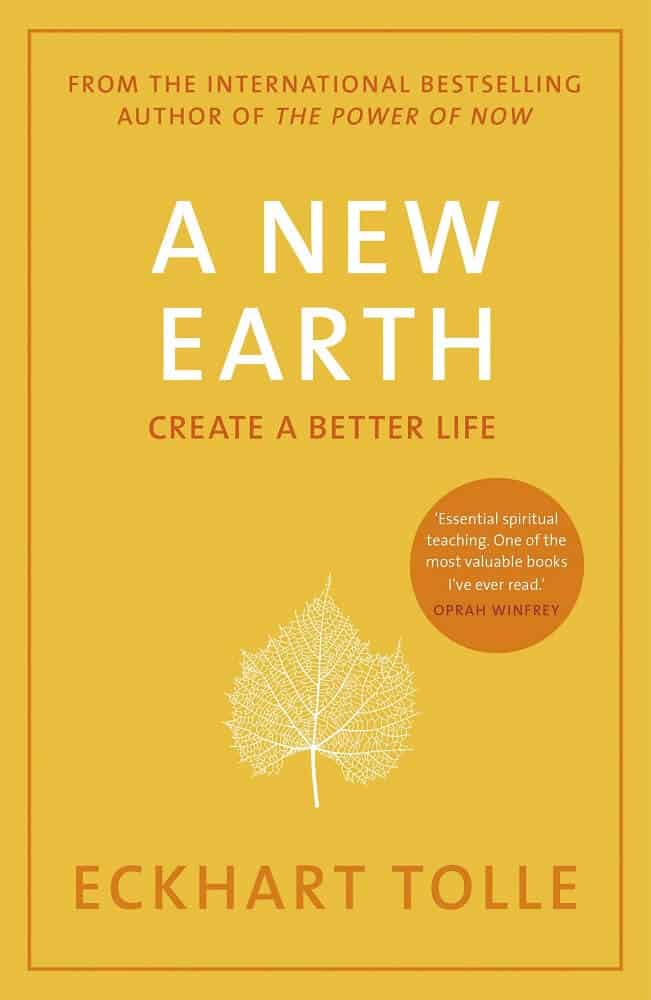
I’d honestly recommend anything Eckhart Tolle has written, including his first book – The Power of Now. A New Earth contains brilliant thought provoking lessons on the power of presence. It’s ‘A wake-up call for the entire planet . . . [A New Earth] helps us to stop creating our own suffering and obsessing over the past and what the future might be, and to put ourselves in the now.” —Oprah Winfrey
Pin it…save it for later…
If you enjoyed this article you may also enjoy:
Married, Solo Travel & Reimagining Bucket Lists: An Interview with Tracy from Travel Bug Tonic
Embracing 60 – Solo Hiker, Traveller, Wild Water Swimmer & Empty Nester: An Interview with Hilary Straw